
Last Updated: November 26, 2026
Quick Summary
You find hidden basement mold by following the moisture trail rather than hunting for dark spots, since mold only grows where water lingers. Check floors near walls, pipes, wall bases, ceilings under bathrooms, and behind stored boxes, then confirm suspect spots with a moisture meter.
- The clearest warning sign is a musty, earthy smell that lingers after airing the room out.
- Detect mold inside walls without demolition by running a moisture meter along the lower wall.
- Mold can start within a day or two after water damage.
- Clean surface mold yourself only if it is under about 10 square feet on a hard surface.
- Call a pro when mold is behind drywall, under carpet, or inside a wall cavity.
Table of Contents
- How Do You Find Hidden Basement Mold?
- Warning Signs of Hidden Basement Mold
- How to Detect Mold Inside Walls Without Tearing Them Open
- Hidden Mold in House Symptoms: What You Might Notice Indoors
- Where Basement Mold Hides: Corners, Baseboards, Pipes, and Stored Belongings
- Can I Get Rid of Basement Mold Myself?
- When to Call a Professional for Hidden Basement Mold
- Request a Mold Inspection from SOS Cleaning & Restoration
- Frequently Asked Questions
How Do You Find Hidden Basement Mold?
You find hidden basement mold by following a moisture trail, not by hunting for dark spots alone. Mold needs water, so the leak, condensation, or damp patch that feeds it is your best clue. This guide shows you where to look, what to sniff for, and when to stop and call a pro.
Most people start by staring at the walls. That is backwards.
Mold spores are everywhere already (Mold Course Chapter 1: | Mold). They only settle and grow where moisture sticks around. So the real question is not “where is the mold?” It is “where is the water?” Answer that and the mold shows itself.
Below, we walk through a safe inspection order, the warning signs that matter, and the point where DIY stops being a good idea.
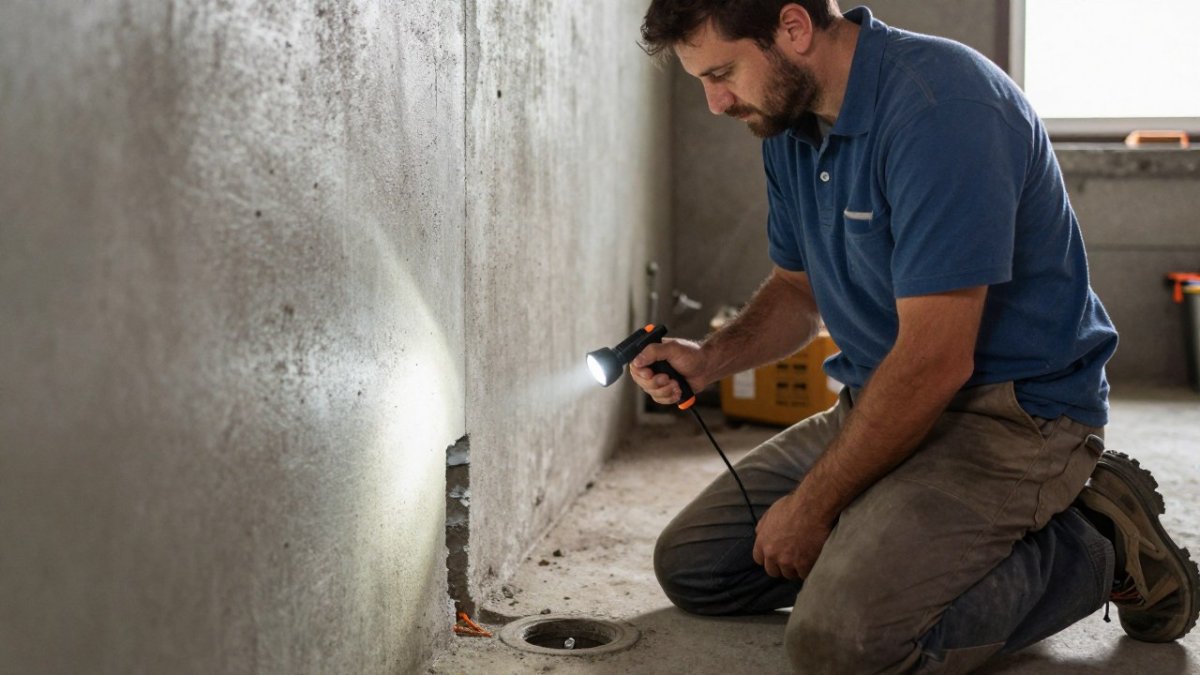
The woman is American.
What You’ll Need Before You Start
You do not need much. A few cheap tools make the job safer and faster:
- A bright flashlight or headlamp
- A moisture meter
- A screwdriver for removing outlet covers
- Disposable gloves and an N95 mask
- A notepad or phone camera to log what you find
Skip the ladder work if you are alone. And never poke holes in walls “just to check.” We will explain why below.
A Safe, Ordered Inspection Sequence
Start at the source and work outward. This order keeps you from missing the obvious.
- Check the floor near the walls for standing water or damp concrete.
- Follow pipes and the water heater for drips or condensation.
- Look at the base of every wall, especially corners.
- Inspect the ceiling under bathrooms and kitchens.
- Pull stored boxes away from walls and check behind them.
- Test suspect spots with the moisture meter.
Log each spot you find. A pattern often points to one source, like a failed downspout or a crack in the foundation.
Warning Signs of Hidden Basement Mold
The clearest warning sign is a musty, earthy smell that does not go away after airing the room out. That smell usually means mold is growing somewhere damp, even if you cannot see it yet. Trust your nose here.
Other signs are easier to spot:
- Dark spots or fuzzy patches on walls, joists, or boxes
- Water stains or rings on the ceiling and floor
- Peeling paint or bubbling walls
- Warped baseboards or soft drywall
- A damp feel on concrete that never dries
If you have had water damage before, mold can start within a day or two. Our guide on preventing mold after water damage walks through the cleanup steps that stop it early.
Musty Odors, Water Stains, and Peeling Paint
That musty odor is the smell of mold spores and the compounds they release. It gets stronger in closed, humid spaces. If a corner of the basement smells worse than the rest, start your inspection there.
Water stains tell a story. A ring on the ceiling means water came through and dried. A fresh, dark stain means it is still coming. Peeling paint and bubbling walls usually mean moisture is trapped behind the surface.
How to Detect Mold Inside Walls Without Tearing Them Open
You can detect mold inside walls without demolition by tracing moisture, not by cutting holes. A moisture meter and a careful visual check will tell you most of what you need to know. Here is how to detect mold inside walls the safe way.
- Run the moisture meter along the lower wall. High readings near the floor point to wicking moisture.
- Remove an outlet cover and shine a light inside. Look for dark fuzz or a musty smell.
- Check where the wall meets the ceiling and floor for staining.
- Look for bubbling paint or soft spots you can press gently.
- Compare readings on an interior wall to an exterior one. A big gap is a red flag.
If those checks point to a problem, you may want a pro to confirm it. Our guide on finding a trusted mold inspector in Prior Lake explains what to ask before you hire anyone.
Hidden Mold in House Symptoms: What You Might Notice Indoors
Some people notice allergy-like reactions that get worse at home and better when they leave.
Watch for:
- Sneezing and a runny nose indoors
- Watery, itchy eyes
- A nagging cough or wheezing
- Sinus irritation or headaches
- Skin irritation
These symptoms can have many causes, so do not assume mold is the reason. But if they ease when you are away from the house and return when you come back, that pattern is worth investigating. People with asthma or a weakened immune system should be extra careful and limit time in damp spaces.
Where Basement Mold Hides: Corners, Baseboards, Pipes, and Stored Belongings
Basement mold hides in the spots that stay damp the longest. Corners, baseboards, and the area around pipes are the usual suspects, but stored belongings are just as common. Cardboard boxes soak up moisture and give mold a perfect surface.
Check these places closely:
- Basement corners where concrete stays cool and damp
- Behind baseboards along exterior walls
- Around pipes, the water heater, and the furnace
- Under flooring, especially carpet over concrete
- Inside and behind stored boxes, furniture, and old clothes
- Behind wall panels and under stairs
Minnesota basements deal with big swings in humidity. Summer air is moist, and cool concrete walls cause condensation. That is why foundation walls and cold pipes grow mold even when there is no visible leak. Because condensation can keep feeding mold growth on cold surfaces, controlling basement humidity and moisture is an important next step, as Basements.com explains.
Can I Get Rid of Basement Mold Myself?
You can clean small patches of surface mold yourself if the area is under about 10 square feet, the growth is on a hard surface like concrete or tile, and you have found and fixed the moisture source. Anything larger, any growth inside walls or under flooring, and any mold that keeps coming back is a job for a pro. The homeowner’s guide to the mold remediation process shows what professional cleanup involves.
A few honest cautions. Bleach does not solve mold the way most people think. It kills surface mold but does not reach roots in porous materials like drywall or wood. Scrubbing without fixing the water source just means the mold comes back. Watch out: dry-scrubbing or sweeping mold releases spores into the air, so wear an N95 mask and gloves and keep the area ventilated.
Use these thresholds to decide whether to clean it yourself or call for help:
- The affected area is larger than roughly 10 square feet, or you cannot tell how far it spreads.
- The mold is behind drywall, under carpet, inside a wall cavity, or around the sill plate.
- Water intrusion keeps returning, or you cannot find where the water is coming from.
- The HVAC system or ductwork is involved, because mold in ducts can spread through the whole house.
- Anyone in the home has asthma, allergies, or a weakened immune system.
On testing: a DIY surface swab or air test kit can tell you that mold spores are present, but it cannot tell you whether the mold is a health problem, where it is coming from, or whether it is the same mold you already see. Spores are in every home’s air, so a single spore count is easy to misread.
If the mold covers a large area, sits behind drywall, or keeps returning, stop. That is when you call in help.
Use these thresholds to decide whether to clean it yourself or call for help.
| Situation | DIY or pro |
|---|---|
| Surface mold under about 10 square feet on hard surface | DIY |
| Area larger than roughly 10 square feet | Call a pro |
| Mold behind drywall, under carpet, or inside wall cavity | Call a pro |
| Water intrusion keeps returning or source unknown | Call a pro |
| HVAC system or ductwork involved | Call a pro |
| Anyone in home has asthma, allergies, or weakened immune system | Call a pro |
When to Call a Professional for Hidden Basement Mold
Call a professional when mold is hidden, widespread, or tied to a water problem you cannot find. At SOS Cleaning & Restoration, we have spent nearly two decades in the field, and we have seen almost everything, including mushrooms growing out of showers. Most people do not know how to deal with mold properly, and containment is the part they miss.
Here is when to bring in a pro:
- Mold is inside walls, under flooring, or behind panels
- The musty smell will not go away after cleanup
- You have had flooding or a burst pipe
- The affected area is larger than a small patch
- Anyone in the home has breathing problems
For local help, you can get mold removal in Prior Lake or review our Prior Lake mold cleanup services. We answer the phone, show up when we say we will, and set up containment so spores stay put during the work.
Request a Mold Inspection from SOS Cleaning & Restoration
Finding hidden basement mold comes down to following the moisture, checking the right spots, and knowing when to stop. If your inspection turns up something that worries you, do not wait for it to spread.
SOS Cleaning & Restoration is locally owned in Prior Lake, MN, and we are IICRC certified. We offer 24/7 emergency response and mold remediation. We also handle water damage remediation.
Contact SOS Cleaning & Restoration to get a clear answer on what is growing in your basement and how to remove it safely.
Frequently Asked Questions
Can a musty smell mean there is hidden basement mold?
A musty, earthy smell is one of the most reliable signs of hidden basement mold, because mold spores release gases as they grow. If the odor gets stronger when the basement is closed up or the HVAC runs, that points to a concealed source behind drywall, under carpet, or inside stored boxes. Follow the smell to its strongest point and check for damp surfaces nearby. If the odor persists after cleaning and ventilating, a professional inspection is the next step.
Should I test for mold before opening a basement wall?
Testing is useful when you need documentation, such as for a real estate transaction, an insurance claim, or a tenant dispute. Air sampling and surface sampling can confirm what is present, but they cannot tell you where the moisture is coming from. In most cases, a visual inspection plus a moisture meter answers the practical question faster. If you already see discoloration or smell a musty odor, testing delays the fix. Address the moisture source first, then test only if you need proof.
Can hidden basement mold make you sick?
Mold exposure is linked to allergy-like symptoms such as sneezing, watery eyes, sinus irritation, and coughing, especially in people with asthma or sensitivities. Symptoms that ease when you leave the basement and return when you go back down are a strong clue. This is not a diagnosis, and you should talk to a doctor about health concerns. From a building standpoint, persistent symptoms are a reason to inspect for hidden basement mold and moisture rather than wait.
Can I remove hidden basement mold myself?
Small patches on hard surfaces, roughly under 10 square feet, can often be cleaned with detergent and water once the moisture source is fixed. Anything larger, anything inside wall cavities, or any growth on porous materials like drywall and insulation should go to a professional. Bleach is not the answer many people expect: it does not penetrate porous surfaces.
