
Last Updated: November 24, 2026
Quick Summary
Restoration specialist certifications are voluntary industry credentials, and the most widely recognized is the IICRC Certified Firm credential with technician-level designations such as Water Damage Restoration Technician. No single license covers all restoration work in the United States, and most credentials come from trade bodies, not the government. At SOS Cleaning & Restoration, we hold IICRC certification.
- A certification proves training and testing, but it is not a legal license from a state or local government.
- The IICRC Water Damage Restoration Technician course runs two to three days of classroom instruction plus a proctored exam.
- IICRC technician credentials renew on a multi-year cycle requiring continuing education hours plus a renewal fee.
- Specialty credentials like ASD, AMRT and FSRT are stacked on top of the WRT.
- Verify a technician’s certificate number in the certifying body’s online directory before you hire.
Table of Contents
- What certifications do restoration specialists need?
- Water damage restoration certification: the core credential
- Mold remediation certification Minnesota technicians rely on
- Restoration company licenses and certifications: what to expect
- Fire, smoke, and contents restoration credentials
- How to verify restoration credentials before you hire
- Request Emergency Help from a Certified Prior Lake Team
- Frequently Asked Questions
What certifications do restoration specialists need?
Restoration specialist certifications are voluntary industry credentials, and the most widely recognized is the IICRC Certified Firm credential with technician-level designations such as Water Damage Restoration Technician. No single license covers all restoration work in the United States. Most credentials come from trade bodies, not the government. At SOS Cleaning & Restoration, we hold IICRC certification.
Here is the part most homeowners miss. A certification is not the same as a license. A technician can hold three certificates and still be legally unlicensed for certain work in your state.
Licensing vs. certification: the distinction that matters
A license is a legal permit issued by a state or local government. You need one to do certain work. A certification is a credential from a private trade organization. It proves training and testing, not legal authority.
So when you ask what certifications do restoration specialists need, the honest answer is: certifications prove skill, but you still have to check licenses separately.
Here is how the credentials and requirements stack up at a glance.
| Item | Value | Note |
|---|---|---|
| Most widely recognized credential | IICRC Certified Firm with technician designations | Voluntary industry credential, not a government license |
| Core water credential | IICRC Water Damage Restoration Technician (WRT) | Starting point for working technicians |
| WRT course length | Two to three days of classroom instruction | Followed by a proctored, multiple-choice exam |
| Renewal | Multi-year cycle with continuing education hours plus fee | Lapsed cards require retest or reinstatement |
| Specialty credentials | ASD, AMRT, FSRT | Stacked on top of the WRT |
| Mold credential | Applied Microbial Remediation Technician (AMRT) | Covers containment, removal, safe cleanup |
| Fire and smoke credential | Fire and Smoke Restoration Technician (FSRT) | Covers residue types, cleaning, deodorization |
| Company-side credentials | IICRC Certified Firm status, technician cards, state registration | Plus general liability and workers’ comp insurance |
Water damage restoration certification: the core credential
The core water damage restoration certification is the IICRC Water Damage Restoration Technician, or WRT. It covers water categories, contamination levels, and the basics of safe extraction and drying. For a working technician, this is the starting point, and most restoration companies expect it before you touch a wet structure.
The WRT teaches you to tell clean water from gray water from black water, because each one needs different handling. Category 1 is sanitary supply-line water, Category 2 is significantly contaminated (washing machine discharge, toilet overflow with urine but no solids), and Category 3 is grossly contaminated (sewage, floodwater, long-standing water). The category drives what can be saved and what must be discarded.
What the WRT class and exam actually involve
Most IICRC technician courses run two to three days of classroom instruction followed by a proctored, multiple-choice exam. The exact exam format and fees are set by the IICRC and can change, so confirm current details with the certifying body before you register. Travel, lodging, and lost workdays are the costs most new technicians underestimate.
Watch out: some online “WRT certification” offers are study aids, not the proctored IICRC exam. Confirm the course is listed by the IICRC before you pay, or you may finish with a certificate that no employer recognizes.
Renewal and continuing education
IICRC technician credentials are not lifetime awards. They renew on a multi-year cycle, and renewal requires continuing education hours plus a renewal fee. If you let a card lapse, you generally have to retest or complete a reinstatement process, which costs more time than renewing on schedule. Keep your certificates and CE transcripts in one folder; employers and adjusters ask for them.
Specialty credentials stacked on top of WRT
From the WRT, technicians add specialty credentials:
- Applied Structural Drying (ASD) for drying science, psychrometrics, and documentation
- Applied Microbial Remediation Technician (AMRT) for mold and sewage-related microbial work
- Fire and Smoke Restoration Technician (FSRT) for soot, residue, and odor
- Water Damage Restoration Technician plus subfloor and hardwood specialties where a company handles those materials
Applied structural drying and the drying science behind it
Applied structural drying is the credential that separates a technician who dries a room from one who understands why it dries. ASD training covers moisture measurement, psychrometrics, equipment placement, and the documentation that adjusters expect on an insurance claim.
This matters to you as a homeowner. A crew that skips drying science can leave moisture inside walls, which can feed mold later. A common mistake is pulling equipment too early because the carpet feels dry on top.
A role-based sequence for building these credentials
A practical order that most practitioners follow:
- Entry-level technician: WRT first, then FSRT if the company does fire work. Add OSHA-compliant safety training and a respirator fit test.
- Experienced technician (one to three years): ASD for drying and documentation, then AMRT if the company handles mold and Category 3 losses.
- Lead technician or supervisor: add project management and estimating skills, plus the company-level IICRC Certified Firm status if you are building a business.
This sequence matters because ASD and AMRT assume you already understand water categories and contamination from the WRT. Skipping ahead usually means retaking a class later.
Mold remediation certification Minnesota technicians rely on
For mold, the credential most Minnesota technicians rely on is the IICRC Applied Microbial Remediation Technician, or AMRT. It covers containment, removal, and safe cleanup of microbial growth.
Here is what most people get wrong about mold. Bleach does not fix it the way people think, and mold can come back when the water source is not fixed.
Containment is the other piece. This is a job to call a professional for, even if you are handy around the house.
If you are weighing whether to hire help, this guide on how to hire professional mold remediation services walks through the questions to ask. You can also see our mold removal in Prior Lake service for local cleanup.
Restoration company licenses and certifications: what to expect
A reputable restoration company should show you its credentials and proof of insurance before work starts.
Insurance is the one people forget. General liability and workers’ comp protect you if someone gets hurt or something gets damaged on your property. A company that cannot produce a certificate of insurance is a risk.
Certifications to look for on the company side:
- IICRC Certified Firm status for the business itself
- Individual technician cards for WRT, ASD, and AMRT
- State registration for any building or reconstruction work
At SOS Cleaning & Restoration, we are IICRC certified and locally owned in Prior Lake.
Fire, smoke, and contents restoration credentials
Fire and smoke damage needs its own credentials because soot and odor behave nothing like water. The Fire and Smoke Restoration Technician, or FSRT, covers residue types, cleaning methods, and deodorization.
Contents restoration is the piece homeowners rarely think about. Your furniture, clothes, and keepsakes can often be saved, but it takes specific training in cleaning and storage.
How to verify restoration credentials before you hire
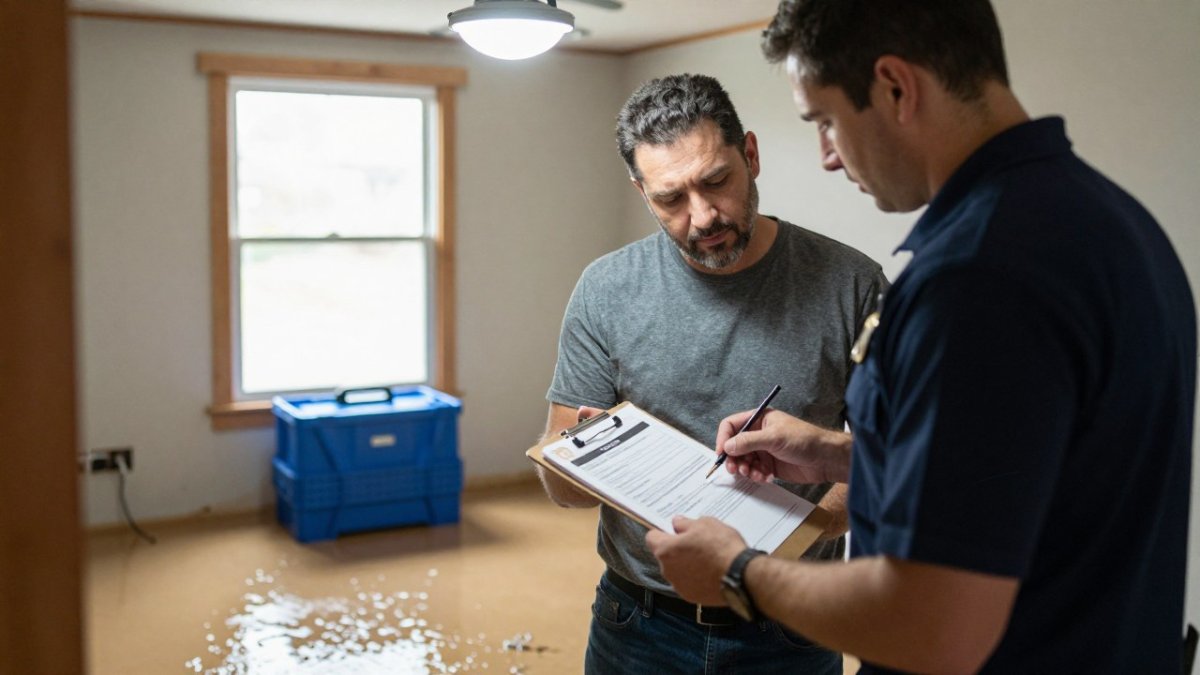
You verify restoration credentials by checking the certifying body’s directory and asking for the certificate of insurance. Do this before you sign anything, not after. The checklist below goes further than most homeowners go, because a card on the wall tells you less than the credential’s status, scope, and relevance to your specific loss.
Step 1: Check the credential is current, not just held
Ask for the technician’s name and certificate number, then look it up in the certifying body’s online directory. A credential that has lapsed, or is in a reinstatement period, is not the same as an active one. IICRC technician cards carry an expiration date; ask to see the card and compare the date to today.
Watch out: a company may display a framed certificate from years ago while the technician on site holds no current card. Verify the person who will actually be in your home, not just the company.
Step 2: Confirm the scope matches your loss
A WRT card covers water damage, not mold remediation or fire cleanup. If your loss involves mold growth, sewage, or smoke residue, ask for the specific specialty credential (AMRT for microbial work, FSRT for fire and smoke). A crew with only WRT training doing mold work is outside the scope of what that credential proves.
Step 3: Verify the company, not just the technician
Company-level credentials are separate from individual cards. Ask for:
- The company’s IICRC Certified Firm number, checked on the IICRC directory
- A certificate of insurance for general liability and workers’ compensation, with the insurer called to confirm it is current
Step 4: Ask about renewal and continuing education
A technician who renews on schedule and completes continuing education is more likely to be current on industry standards. Ask when the technician last renewed and what CE courses they have taken. This is a fair question, and a reputable company will answer it without hesitation.
Step 5: Get the plan in writing
Ask for the drying plan, moisture readings, and the scope of work in writing before work starts. A certified technician should be able to explain why each piece of equipment is placed where it is and what readings will trigger removal. If the answer is vague, the credential is not being used the way it should be.
For a deeper walkthrough, read our guide on hiring an emergency restoration company. You can also check our FAQ page for quick answers before you book.
Request Emergency Help from a Certified Prior Lake Team
Water in your basement at 2 AM does not wait for business hours. Neither should you have to guess whether the crew at your door is qualified.
SOS Cleaning & Restoration serves Prior Lake and the surrounding area. We are IICRC certified, locally owned, and available around the clock for water damage, mold, and cleaning emergencies.
If you are searching for restoration services near me, our 24/7 local response team is ready to help. Get started with SOS Cleaning & Restoration and get your home dry, safe, and back to normal.
Frequently Asked Questions
Are restoration certifications required by law or voluntary?
Most restoration certifications are voluntary, but the work they cover is not unregulated. Certifications from bodies like the IICRC are voluntary credentials that show a technician completed training and passed an exam. A company can hold a valid license and still have uncertified staff, so ask about both: the license that makes the work legal and the certification that shows technical training.
What is the difference between a restoration certification and a contractor license?
A contractor license is issued by the state and gives a company legal permission to perform certain work, such as building repair or mold remediation. A restoration certification is a private credential, usually from the IICRC, that confirms a technician passed training in a specific discipline like water damage or applied structural drying. Licenses are mandatory and enforceable; certifications are voluntary and signal expertise. When you hire, check the license through the state and the certification through the issuing body.
How can I verify a restoration technician’s certification?
Ask the company for the technician’s name and certification number, then check the issuing organization’s online directory. The IICRC maintains a searchable list of certified firms and technicians. A legitimate restoration company will provide this information without hesitation.
Do mold remediation specialists need a license in Minnesota?
Certifications such as the IICRC’s applied microbial remediation credential show that a technician trained in remediation procedures. For a mold problem in Prior Lake or anywhere in the Twin Cities metro, ask for both before signing anything.
