
Last Updated: November 14, 2026
Quick Summary
To identify water damage sources, first read the clues your house shows: yellow stains that turn into brown rings, musty smells, peeling paint, and buckling surfaces. Then trace each stain to its highest point and confirm with a water meter test and a moisture meter before opening any wall.
- A fresh leak often leaves a yellow stain that turns brown and forms rings as it dries and repeats.
- With all fixtures off, read your water meter, wait 30 to 60 minutes, and read it again to confirm an active leak.
- Shut off suspect fixtures one at a time and watch the stain for 30 to 60 minutes to narrow the source.
- A moisture meter is the single most useful tool for homeowners because it shows where the wet zone ends.
- Shut off the main water valve if you see active spraying, fast pooling, or a stain spreading by the minute.
Table of Contents
- Start With the Signs of Water Damage in a Home
- Common Water Damage Sources Room by Room
- How to Find a Water Leak Inside a Wall
- How to Identify Water Damage Sources in a Bathroom
- Water Leak Detection Tools That Narrow the Search
- Tell Plumbing Leaks Apart From Roof, Condensation, and Groundwater
- When to Shut Off Utilities or Call a Restoration Pro
- Request Emergency Help for a Leak You Cannot Trace
- Frequently Asked Questions
Start With the Signs of Water Damage in a Home
The first step in learning how to identify water damage sources is reading the clues your house already shows you. Water almost always leaves a mark before it becomes a crisis.
Water damage is any unwanted moisture that stains, warps, or rots building materials. The signs of water damage in a home usually appear before you ever see standing water.
Here is where to look first.
Water Stains, Brown Rings, and Discoloration
Water stains are the most reliable early clue. A fresh leak often leaves a yellow stain. As it dries and repeats, the mark turns brown and forms brown rings around the edge.
Check ceilings, wall corners, and the top of baseboards. A stain that grows after rain points to a roof or window leak. One that shows up after a shower points to plumbing.
Musty Smells, Peeling Paint, and Buckling Surfaces
Your nose is a tool. A musty smell in a closed room usually means damp materials are feeding mold or mildew.
Then look for peeling paint, bubbling paint, and buckling surfaces. Paint bubbles when moisture pushes from behind.
If a persistent odor or a damp patch has you worried, our guide on Prior Lake mold cleanup explains what that smell may be telling you.
Common Water Damage Sources Room by Room
Most water damage sources fall into a few predictable groups. Walking your home room by room helps you match a symptom to a likely cause.
Plumbing, Pipes, and Fixture Failures
Plumbing is the number one indoor culprit. Watch for burst pipes, frozen pipes in winter, and slow drips under sinks. Supply lines behind the washer and the toilet are common failure points.
Small leaks waste water quietly for weeks. By the time you spot the stain, the wall cavity behind it may already be wet.
Appliances, Water Heaters, and Sprinkler Systems
Appliances fail without warning. A water heater tank can rust through and dump its full contents. Dishwashers, ice makers, and washing machines leak from worn hoses.
Outdoors, a broken sprinkler system line soaks the ground next to your foundation. That water finds its way into the basement through cracks and drainage gaps.
How to Find a Water Leak Inside a Wall
Finding a hidden leak is a process of elimination, not a guess. The goal is to narrow the source before you open a wall, and to stop at clear safety checkpoints.
Use this ordered workflow. Do not skip ahead.
- Make the area safe first. If water is near outlets, a panel, or a light fixture, turn off power to that circuit at the breaker before you touch anything. If the water smells like sewage or looks black, stop and call a professional. Those are stop points, not steps to work around.
- Confirm the water is active. With every tap, appliance, and irrigation zone off, read your water meter. Write down the reading and the time. Wait 30 to 60 minutes with no water use and read it again. A moving dial or a rising digital count means an active supply-side leak. A steady meter points you toward a drain, roof, condensation, or groundwater source instead.
- Trace the stain to its highest point. Water runs down and along framing, so the visible mark is usually below the source. Follow the wet zone upward and outward. A stain that is widest at the top and narrows downward is telling you the entry point is above.
- Isolate suspect fixtures one at a time. Shut off the supply valve to the nearest sink, toilet, or appliance and watch the stain for 30 to 60 minutes. If it stops growing, you have narrowed the source to that branch. If it keeps growing, reopen the valve and move to the next suspect.
- Listen in a quiet house. Turn off fans and appliances and listen at the wall. A hiss or drip that continues with all fixtures off supports an active supply leak; silence with a wet wall supports condensation or a drain issue.
- Map the wet zone with a moisture meter. Scan outward from the stain in a grid until readings drop to dry-wall baseline. Mark the boundary with painter’s tape so you can tell whether it grows. This is what tells you how far the damage reaches before anyone cuts.
- Confirm before you open. Only cut drywall after the meter reading, the isolation test, and the moisture map agree on a location. Opening a wall on a hunch is how a small repair becomes a large one.
Watch out: a moving water meter with all fixtures off can also mean an irrigation line, a humidifier, or a refrigerator ice maker is running. Check those before you assume a pipe inside the wall has failed.
Once you confirm a leak, act fast to stop mold. Our guide on how to stop mold after a pipe burst walks through the cleanup steps, and how to spot hidden mold growth covers the signs to watch for.
How to Identify Water Damage Sources in a Bathroom
Bathrooms hide more leaks than any other room.
Start with the tub and shower surround. Cracked caulk and failed grout let water slip behind tile.
Look under the sink for damp cabinet bottoms. Then check the supply lines and shutoff valves. A tiny drip here rots the cabinet and the floor below.
Bathroom exhaust fans matter too. Without one, humidity from showers condenses on cold walls and mimics a leak.
Water Leak Detection Tools That Narrow the Search
The right tools turn a mystery into a location, but only if you understand what each one actually proves.
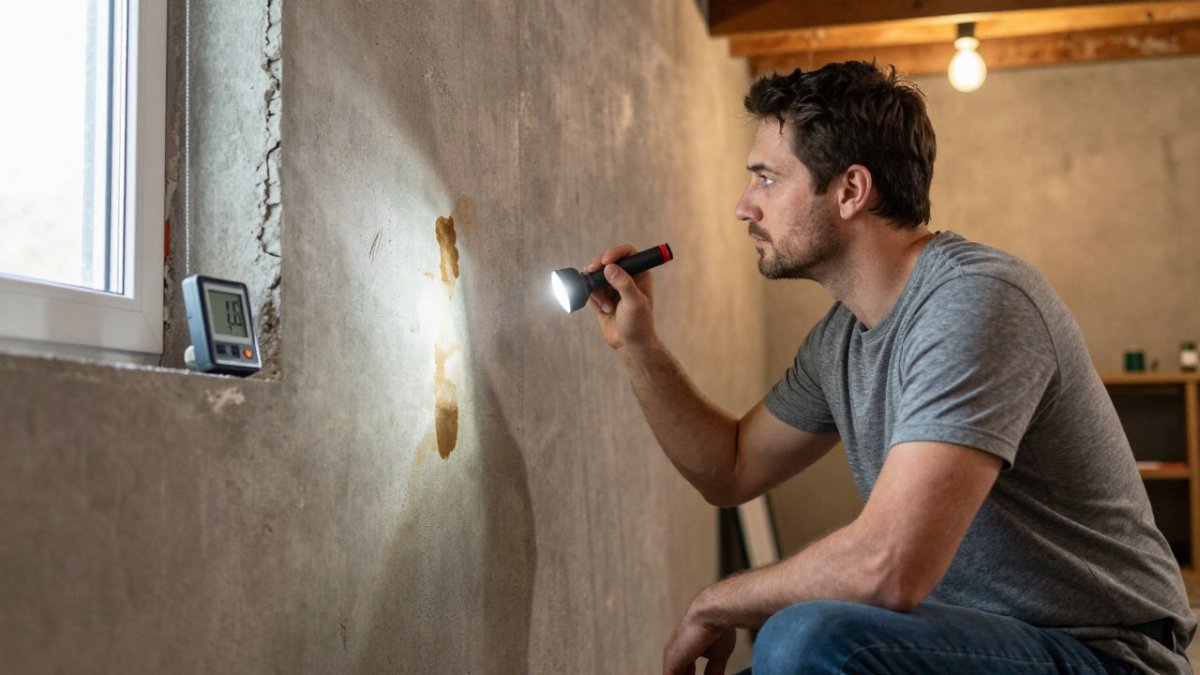
- Flashlight: lights up dark corners, crawlspaces, and cabinet interiors. It confirms visible staining and surface moisture but cannot detect water behind a surface.
- Digital hygrometer: measures relative humidity to show whether a room is abnormally damp. Compare an affected room to an unaffected room on the same floor; a sustained difference supports a hidden moisture source. It does not locate the source.
- Moisture meter: pinpoints wet spots inside walls and under floors. Pin-type meters read at the surface; pinless meters scan through a surface. Neither measures how much water is present, only relative wetness, so use it to map boundaries and track change over time.
A moisture meter is the single most useful tool for homeowners. It tells you where the wet zone ends so you know how far the damage reaches.
Watch out: a moisture meter can read high on materials that are cold or metallic, and a hygrometer can read high in a bathroom that was just used.
For a leak you cannot trace, our emergency restoration services nearby offer 24/7 response. Before you hire anyone, read our tips on hiring an emergency restoration company so you choose a certified, trustworthy team.
Tell Plumbing Leaks Apart From Roof, Condensation, and Groundwater
Not every wet spot is a plumbing leak. Telling the causes apart saves you from tearing open the wrong wall.
Ask one question: when does it appear?
- Plumbing leaks show up steadily, day or night, and often near fixtures.
- Roof leaks appear after rain and stain ceilings near exterior walls.
- Condensation forms on cold surfaces in humid weather, not from a single point.
- Groundwater intrusion seeps in at the basement floor and lower walls after heavy rain or snowmelt.
Prior Lake sits near lakes and wetlands, so spring snowmelt and summer storms push groundwater against foundations. A sump pump that fails during a storm is a common cause of a wet basement here. If water rises from the floor rather than the ceiling, suspect groundwater, not pipes.
When to Shut Off Utilities or Call a Restoration Pro
Some leaks are safe to trace yourself. Others need the water off and a pro on the phone. Knowing the difference protects your home and your safety.
Shut off the main water valve if you see active spraying, water pooling fast, or a stain spreading by the minute. For a water heater leak, shut off its supply and power.
Call a professional when:
- You cannot find the leak source after a careful search.
- Water has soaked drywall, insulation, or flooring for more than a day.
- You smell a musty smell or see mold.
- The wet area is large or keeps returning.
For a leak you cannot trace, our emergency restoration services nearby offer 24/7 response. Before you hire anyone, read our tips on hiring an emergency restoration company so you choose a certified, trustworthy team.
Request Emergency Help for a Leak You Cannot Trace
Some leaks stay hidden no matter how carefully you look. When the stain keeps growing and the meter keeps spinning, it is time to bring in help.
Here is a simple summary to guide your next move:
| What You See | Likely Cause | Your Next Step |
|---|---|---|
| Brown ring on ceiling after rain | Roof or window leak | Check attic and flashing, call a roofer |
| Steady drip under sink | Plumbing or fixture failure | Shut off supply, repair the line |
| Musty smell, no visible water | Hidden leak or mold | Test with a moisture meter, call a pro |
| Water rising from basement floor | Groundwater or sump failure | Check sump pump, call for extraction |
| Stain grows with every flush | Toilet wax ring or drain | Stop using fixture, call a plumber |
At SOS Cleaning & Restoration, our IICRC-certified team serves Prior Lake and the surrounding MN area with fast, local response.
Do not wait for a small stain to become a big repair.
A hidden leak rarely fixes itself, and every day of moisture raises the risk of mold.
Frequently Asked Questions
How can I tell where water damage is coming from?
Work from the visible sign backward. Note whether the stain, bubbling paint, or musty smell sits high on a wall, at floor level, or under a fixture, because that narrows the water damage sources to roof or envelope leaks, plumbing, or groundwater. Check the water meter with every fixture off: if the dial still moves, the leak is on the pressurized supply side. A moisture meter then confirms which materials are wet and how far the water has traveled.
Can a water meter help identify a hidden leak?
Yes. Shut off every faucet, appliance, and irrigation zone, then watch the meter’s leak indicator or low-flow dial for 15 to 20 minutes. Any movement means water is escaping somewhere on the supply line. Repeat the test with the main valve closed; if the meter stops, the leak is inside the house rather than between the meter and the foundation. This is one of the simplest water leak detection tools and costs nothing to run.
How do I check for water damage in a bathroom?
Look below and behind the wet zones. Inspect the ceiling under an upstairs bathroom, the floor around the toilet base, the caulk line at the tub, and the cabinet under the sink. Soft or discolored subfloor, a rocking toilet, or peeling paint on the wall behind the tile points to a slow leak. A moisture meter reading on surrounding drywall confirms whether the water has spread beyond the fixture itself.
When should I call a water damage restoration professional?
Call when the source is hidden inside a wall or slab, when more than a small area is wet, when you smell a musty odor or see possible mold, or when the water came from a sewage backup. Standing water and wet insulation also need fast extraction to prevent mold growth. A certified team can measure moisture, document conditions for your insurer, and dry the structure properly.
