
Last Updated: November 17, 2026
Quick Summary
The water restoration cost for an emergency depends on how much water got in, what kind of water it is, how far it has spread, and how fast crews can start drying. No honest company quotes a flat price over the phone, because the price is set by the damage, not the address. The three numbers that decide your bill are the square footage of wet material, the water category, and how many days drying equipment runs.
- Extraction takes hours, but structural drying takes days, and equipment fees and monitoring visits stack up.
- Category 3 black water from sewage backups is treated as hazardous and usually requires removing porous materials.
- Mitigation and reconstruction are two separate invoices, and most homeowner policies handle them differently.
- A typical water damage restoration timeline runs three to five days for drying, plus reconstruction time.
- Water that sits 24 to 48 hours starts feeding mold, and mold remediation adds days and dollars.
Table of Contents
- What Drives the Cost of Emergency Water Restoration
- How to Shut Off Your Main Water Valve Before Crews Arrive
- Water Damage Categories and Classes: Why Clean Water Costs Less Than Black Water
- Emergency Mitigation vs. Long-Term Repair: Two Separate Bills
- A Realistic Water Damage Restoration Timeline
- The Water Damage Insurance Claim Process, Step by Step
- Hidden Cost Triggers That Inflate the Final Bill
- Request Emergency Help from SOS Cleaning & Restoration
- Frequently Asked Questions
What Drives the Cost of Emergency Water Restoration
The water restoration cost for an emergency in Prior Lake, MN depends on four things: how much water got in, what kind of water it is, how far it has spread, and how fast crews can start drying. No honest restoration company quotes a flat price over the phone, because the price is set by the damage, not by the address.
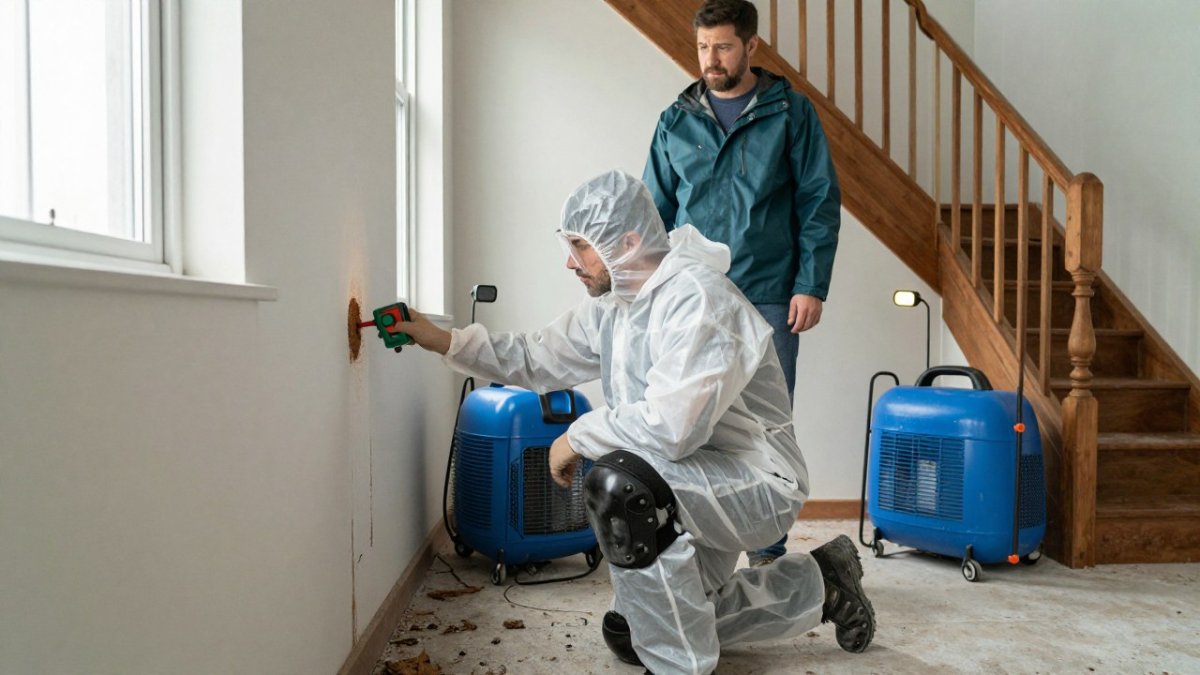
This guide from SOS Cleaning & Restoration breaks down what moves the bill, how insurance handles it, and where homeowners get surprised.
Water damage is measured in three dimensions: category (contamination), class (how much it has soaked in), and square footage. A burst supply line in a finished basement is a different job from a sewage backup of the same square footage.
The most important number on any estimate is not the extraction line, it is the drying line. Extraction takes hours; structural drying takes days, where equipment fees, labor, and monitoring visits stack up.
The per-square-foot ranges you should expect
- **
Pricing depends on the water category, the affected square footage, and how long drying takes. For a current price or a quote, contact SOS Cleaning & Restoration directly.
What each line item actually is
A real estimate is built from measurable line items:
- Water extraction: truck-mount or portable extraction, priced per square foot of affected area.
- Structural drying: air movers and dehumidifiers priced per unit per day, typically three to five days.
- Antimicrobial application: priced per square foot of treated surface.
Why Prior Lake jobs land where they do
Local conditions move the number as much as the damage does. Prior Lake and Scott County sit on ground that drains slowly in spring, and homes near the lake and in low-lying neighborhoods see more basement seepage and sump failures. Older housing stock near downtown Prior Lake often has original cast-iron drains and finished basements built without modern waterproofing, raising the odds of a Category 2 or 3 loss.
The three numbers that decide your bill
If you remember nothing else, remember these: the square footage of wet material, the category of the water, and how many days the drying equipment runs. A 400-square-foot Category 1 loss caught in the first few hours is a fundamentally different invoice from a 400-square-foot Category 3 loss discovered two days later. That is why the fastest, most accurate answer to “what will this cost” comes after a moisture map.
How to Shut Off Your Main Water Valve Before Crews Arrive
Shutting off your main water valve stops the source and is one of the most useful things you can do before a crew arrives.
Here is the sequence that limits damage:
- Shut off the main valve by turning it clockwise until it stops.
- Open a low faucet to drain pressure from the lines.
- Kill power to any flooded area at the breaker panel, but never wade into standing water to reach it.
- Move furniture and rugs off wet carpet, and lift items off wet floors.
- Call for emergency help and photograph everything before anything is moved out.
If the valve is seized or you cannot find it, shut off at the meter or call the city.
When you call, tell the dispatcher where the water is coming from and whether it is clean or dirty.
Water Damage Categories and Classes: Why Clean Water Costs Less Than Black Water
Water damage is classified by contamination, and the category decides how much material can be saved. Clean water from a supply line is Category 1. Gray water from a washing machine or dishwasher is Category 2.
Category 3 water changes the job completely. Porous materials that would be dried in a Category 1 loss, carpet, pad, and drywall, usually get removed and disposed of instead. Crews wear full protective equipment, and the space gets sanitization and disinfection, not just drying. Sewage backup cleanup also carries a higher risk of mold and bacteria, which is why the labor and disposal lines are longer.
Class works alongside category. Class 1 means minimal absorption. Class 4 means deep saturation in materials like hardwood, concrete, and subfloor assemblies, which need specialty drying and much longer equipment run times.
| Category | Source Example | Typical Handling | Cost Impact |
|---|---|---|---|
| Category 1 (clean) | Burst supply pipe | Extract, dry in place | Lowest |
| Category 2 (gray) | Washing machine overflow | Extract, sanitize, selective removal | Moderate |
| Category 3 (black) | Sewage backup, outdoor flood | Remove porous material, disinfect | Highest |
| Class 1 | Small, fast-detected spill | Air movers only | Low |
| Class 2 | Wet carpet across a room | Air movers plus dehumidification | Moderate |
| Class 3 | Water from overhead | Aggressive drying, ceiling work | High |
| Class 4 | Hardwood, concrete, subfloor | Specialty drying, longer runtime | Highest |
Emergency Mitigation vs. Long-Term Repair: Two Separate Bills
Emergency mitigation and reconstruction are two different invoices, and confusing them is the most common source of billing shock. Mitigation is the emergency work: extraction, structural drying, dehumidification, moisture mapping, and mold prevention. Reconstruction is putting the house back together: drywall, subfloor repair, paint, trim, and flooring.
Most homeowner policies handle these differently. Mitigation is usually treated as emergency protection of the property. Reconstruction may fall under dwelling coverage, with its own deductible treatment. Ask your adjuster which bucket each line item lands in before you approve anything.
This split is also why a “cheap” mitigation quote can cost more overall. Fast, thorough drying protects the structure and shrinks the reconstruction bill.
A Realistic Water Damage Restoration Timeline
A typical water damage restoration timeline runs three to five days for drying, plus reconstruction time if walls or floors come out. Category 1 losses with fast response often dry in two to three days; Category 3 losses with saturated assemblies can run a week or more before drying is verified.
Day one is emergency response: extraction, moisture mapping with thermal imaging and hygrometers, and equipment placement. Days two through four are structural drying with air movers and dehumidification, plus monitoring visits to log readings.
The Water Damage Insurance Claim Process, Step by Step
The insurance claim process starts with one call to your insurer and one to a restoration company, in either order. Report the loss, get a claim number, and ask what documentation the adjuster wants.
Follow this sequence:
- Photograph and video every affected room before cleanup begins.
- Keep a written log of dates, times, and who you spoke with.
- Save damaged items for the adjuster before disposal, when safe.
Your deductible applies to the claim, so know that number before you decide whether to file. See the Emergency Water Damage Restoration: Prior Lake Response Guide.
Hidden Cost Triggers That Inflate the Final Bill
Hidden cost triggers are the items that appear mid-job and push the final water restoration cost above the initial estimate. They are not scams. They are conditions nobody can see until walls open and meters read. What separates a fair bill from a painful one is whether the contractor priced the known unknowns up front and explained what would trigger a change order.
The triggers, and what each one actually costs
- Hidden moisture behind walls and under floors. Thermal imaging often finds wet framing the eye cannot see. Opening a wall to dry a cavity adds labor, drying equipment, and later drywall repair, commonly a few hundred to a couple thousand dollars once the cavity is opened and refinished.
- Mold discovered after drying starts. Mold remediation is a separate scope with containment, negative air, HEPA filtration, and antimicrobial treatment. Because it is billed separately from water mitigation, it is the single most common reason a final invoice exceeds the initial estimate.
- Asbestos or lead in older homes. Homes built before the late 1970s can contain materials such as asbestos or lead paint, so testing before demolition is worth asking about.
How change orders work, and how to keep them fair
A change order is a written authorization for work beyond the original scope. Legitimate change orders are normal on water losses, because damage is often hidden. The problem is when they appear without documentation.
Protect yourself with four habits:
- Demand a written scope with unit pricing before work starts. You should see a price per square foot, per unit per day, and per line item, not a single lump sum.
- Ask in writing what would trigger a change order. A good contractor can name the likely triggers for your specific loss.
- Require photos and moisture readings before any added scope is approved. The documentation should justify the change, not just announce it.
- Get the drying logs. Daily readings prove the equipment was necessary and the job was run correctly, and they are what your adjuster will want.
Watch out: a contractor who cannot explain the pricing structure, resists putting unit costs in writing, or treats every change order as routine is one to walk away from.
The cheapest line item is the one you avoid
Speed is one of the main ways to limit hidden costs. Starting extraction and drying within the first day or two can reduce the risk of mold, swollen subfloors, and demolition. If you are unsure whether a loss is worth calling about, it is reasonable to ask a restoration company for an assessment.
Request Emergency Help from SOS Cleaning & Restoration
When water is spreading, the fastest path to a smaller bill is a fast, qualified crew. SOS Cleaning & Restoration is locally owned in Prior Lake, MN, IICRC certified, and offers 24/7 emergency response for water damage mitigation and mold remediation.
If you are comparing companies, consider certification, written scope, response time, and whether they explain the mitigation versus reconstruction split up front. For more criteria, read Tips for Hiring an Emergency Restoration Company. To discuss water damage restoration in Prior Lake, MN, contact SOS Cleaning & Restoration.
Water damage gets more expensive with every hour it sits, and mold does not wait for a convenient week. If you are standing in water right now, shut off the source if you safely can and call for help.
Frequently Asked Questions
How much does water restoration cost per square foot?
There is no single national rate. Water restoration cost per square foot depends on the water category, how deeply materials are saturated, and whether reconstruction is needed. Category 1 clean water in a small area costs far less per square foot than Category 3 black water that requires removing drywall, sanitizing framing, and replacing subfloor. Local labor rates and equipment fees also shift the number. Ask for a room-by-room estimate with square footage and line items so you can compare bids fairly.
Is emergency water restoration covered by homeowners insurance?
Most standard homeowners policies cover sudden, accidental water damage, such as a burst pipe or appliance failure. Damage from long-term neglect or repeated leaks is usually excluded. Your deductible applies before the policy pays, so a small cleanup may cost less than filing. Review your policy language, photograph everything before work starts, and keep every invoice. Your insurer may also require mitigation within a set window to prevent mold, so call a restoration company early.
What is the difference between water mitigation and water restoration?
Water mitigation stops the damage: extraction, structural drying, dehumidification, and sanitization. Water restoration rebuilds what was removed or damaged, including drywall, flooring, and trim. Insurers often handle these as separate line items, and mitigation is usually the urgent part. Ask your contractor to separate mitigation costs from reconstruction costs in the estimate so you can see exactly what insurance covers and what you pay out of pocket.
Can I do emergency water extraction myself to save money?
You can remove standing water with a wet/dry vacuum and move belongings off wet floors, which may reduce the bill. What you cannot easily replicate is structural drying. Without air movers, dehumidifiers, and moisture mapping, trapped water stays inside wall cavities and subfloor, and mold can begin within 24 to 48 hours. If the water is Category 3 black water or covers more than a small area, professional extraction and drying is the safer and usually cheaper choice long term.
