
Table of Contents
- Why Commercial Mold Remediation Matters for Your Building
- Commercial Mold Inspection and Initial Assessment
- The Commercial Mold Remediation Process Explained
- What to Look for in Mold Remediation Company Qualifications
- Professional Mold Remediation Cost Factors
- Business Continuity and Tenant Coordination During Remediation
- Documentation, Insurance, and Compliance
- Prevention and Ongoing Moisture Monitoring
- Frequently Asked Questions
Last Updated: October 11, 2026
Why Commercial Mold Remediation Matters for Your Building
Commercial property mold remediation services protect your building’s structural integrity and occupant health. Mold grows rapidly in moisture-rich environments and can compromise everything from HVAC systems to load-bearing walls. Left untreated, it spreads across multiple floors and becomes exponentially more expensive to address.
Commercial mold creates liability exposure through regulatory scrutiny, tenant complaints, and legal risk. Prompt professional remediation costs far less than ignoring early signs.
Mold thrives in spaces with poor ventilation, water intrusion, or humidity above 60%. A single water event, burst pipes, roof leaks, HVAC condensation, triggers widespread contamination within 48 hours. Commercial property mold remediation services address the root cause and eliminate visible and hidden growth before it becomes a crisis.
Attempting DIY mold removal in commercial spaces violates OSHA standards and can spread spores throughout your building’s ventilation system, making the problem worse.
Commercial Mold Inspection and Initial Assessment
Professional commercial mold inspection identifies contamination before it becomes visible. Assessment includes moisture mapping, air quality testing, and visual inspection of high-risk areas: basements, crawl spaces, HVAC units, and roof penetrations.
Inspectors use moisture meters and thermal imaging to detect water intrusion behind walls and ceilings, collect air samples to identify mold species and spore counts, and establish baseline data that determines remediation scope and containment strategy.
The inspection report documents affected areas, moisture sources, and remediation steps, critical for insurance claims and regulatory compliance. It provides baseline data to verify remediation success and prove due diligence.
Request moisture readings in writing during the initial assessment. These readings create a documented baseline that protects you if mold recurs after remediation.
The Commercial Mold Remediation Process Explained
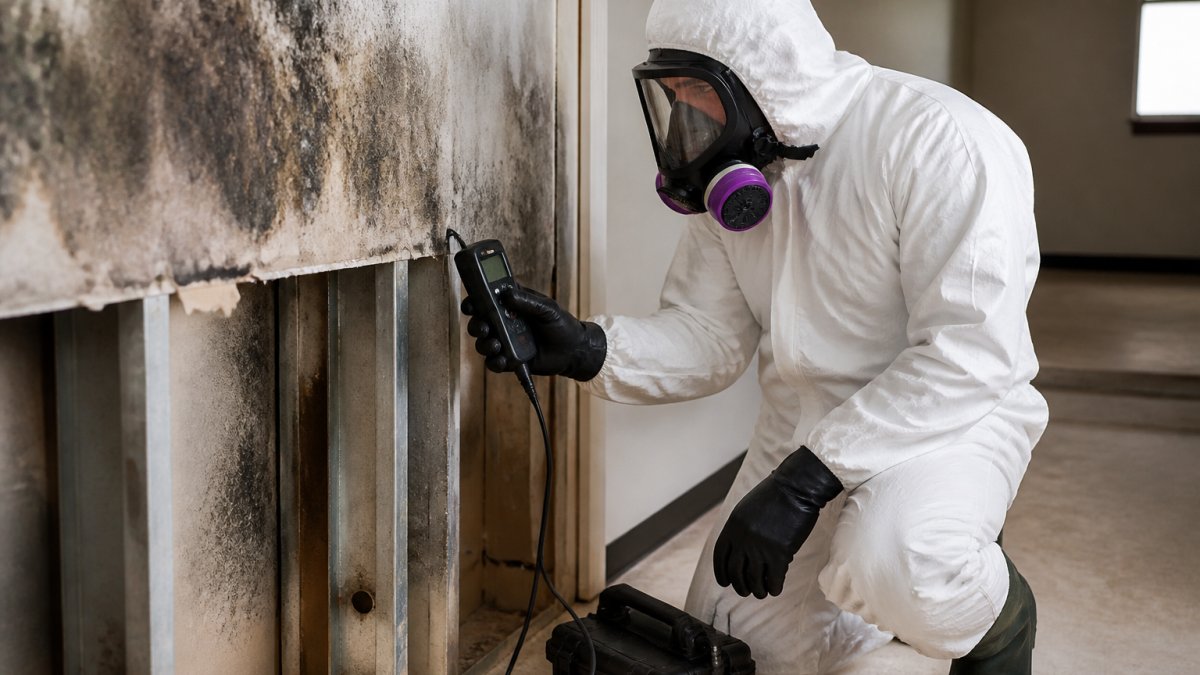
Commercial property mold remediation services follow a structured protocol: containment, material removal and surface treatment, moisture control, and clearance testing.
Moisture Source Identification and Containment
Identifying the moisture source is non-negotiable; if water continues entering, mold returns within weeks. Common sources: roof leaks, plumbing failures, HVAC condensation, and foundation seepage. Remediation succeeds only when the source is sealed.
Containment prevents spore spread during removal. Workers establish negative air pressure using HEPA-filtered equipment, seal doorways with plastic barriers, and control dust migration to protect ventilation systems and prevent cross-contamination.
Material Removal and Surface Cleaning
Contaminated materials, drywall, insulation, flooring, are removed per EPA guidelines. Porous materials absorb mold deep into their structure and cannot be salvaged. Non-porous surfaces are cleaned with EPA-approved antimicrobial treatments and HEPA-vacuumed to remove residual spores.
Professional remediation includes controlled disposal and air filtration. Rushing this phase leaves dormant spores that germinate when moisture returns.
Drying, Restoration, and Final Clearance
Industrial dehumidifiers and air movers reduce moisture to safe levels (below 50% relative humidity) in 24-72 hours depending on area size and material types. Premature occupancy before complete drying creates conditions for new mold growth.
Final clearance involves post-remediation air quality testing by a third-party inspector to verify spore counts return to normal outdoor levels. This clearance report proves remediation success and is essential for insurance documentation.
What to Look for in Mold Remediation Company Qualifications
Choosing the right remediation provider affects success, cost, and liability protection. Evaluate providers across six key dimensions using a structured vetting checklist.
Certifications and Training Standards
IICRC (Institute of Inspection, Cleaning and Restoration Certification) credentials indicate standardized training in water damage restoration, mold remediation, and containment protocols. IICRC-certified firms maintain continuing education and adhere to published standards.
Beyond IICRC, verify that the company’s lead technicians hold state-specific licenses if your jurisdiction requires them. Some states regulate mold remediation contractors; others do not. Confirm whether your building’s location has licensing requirements and whether the provider meets them.
Insurance Coverage and Bonding
General liability insurance protects you if the contractor damages your building or injures a worker. Workers’ compensation insurance is legally required and protects you from liability for contractor injuries.
Commercial Experience and References
Residential contractors may lack expertise for large-building remediation, phased work, or tenant coordination. Request references from commercial property managers for similar-sized projects.
Ask references about: timeline adherence, communication quality, transparent handling of hidden contamination or scope changes, post-remediation mold recurrence, and whether final invoices matched estimates.
Response Time and Availability
Commercial mold emergencies require rapid mobilization. Confirm 24/7 emergency response commitment and ask whether a technician is dispatched within 2 hours or if only phone consultation is immediate.
Ask whether the contractor mobilizes crews for after-hours or weekend work and clarify whether emergency response incurs premium rates or is included in standard pricing.
Clearance Testing and Independence
Ask whether the contractor performs clearance testing in-house or uses an independent third-party inspector. Independent testing carries more weight with regulators and insurance carriers because the testing firm has no financial incentive to declare remediation successful.
If the contractor uses in-house testing, ask whether they accept results from an independent inspector you hire separately. Willingness to accept third-party testing is a positive sign.
Scope Definition and Warranty
Request itemized proposals that clearly separate inspection, containment, removal, treatment, drying, and clearance testing. Vague proposals like “complete mold remediation” create disputes when hidden contamination emerges mid-project.
Ask whether the contractor warrants work against mold recurrence within 12 months if the moisture source remains sealed. A written warranty demonstrates confidence in their process.
Documentation and Reporting Standards
Confirm the contractor provides written reports documenting affected areas, moisture sources, materials removed, disposal methods, and clearance test results. Request a sample report before hiring.
Create a simple spreadsheet listing the six vetting dimensions above, score each contractor on a scale of 1-5 for each dimension, and compare total scores. This systematic approach removes emotion from the decision and creates a documented record of your due diligence.
Professional Mold Remediation Cost Factors
Remediation costs vary widely based on contamination extent, building characteristics, and approach. Understanding cost drivers enables accurate budgeting and fair quote comparison.
Affected Area Size and Material Types
Square footage is the foundation of cost estimation, but material type drives removal and replacement expense.
Ask contractors to estimate the percentage of affected area that is porous versus non-porous to clarify cost differences between quotes.
Moisture Source Complexity and Accessibility
Obvious, easily sealed sources (single roof leak, accessible burst pipe) mean straightforward remediation.
Older buildings with multiple wall cavities and outdated HVAC systems require more thorough inspection.
Ask whether the initial assessment revealed the moisture source or if additional investigation is needed.
Containment and Dust Control Requirements
Containment labor and materials, plastic barriers, negative air pressure equipment, HEPA filtration, add cost proportional to affected area and building complexity.
A single office requires minimal containment; multi-floor contamination requires extensive containment with sealed barriers, multiple negative air units, and continuous monitoring.
Material Removal and Disposal
Removal labor is time-intensive. Disposal costs depend on contamination classification and local regulations.
Drying Duration and Equipment
Drying duration depends on affected area size, material types, and ambient humidity.
Equipment rental costs accumulate daily. Ask contractors to explain drying timeline estimates and what conditions might extend them.
Restoration and Reconstruction
Once contamination is removed, damaged materials must be replaced. Contractors may quote remediation separately from reconstruction or bundle both.
Request separate line items for remediation and reconstruction to clarify what is included and where costs concentrate.
Post-Remediation Clearance Testing
In-house testing typically costs $500-$1,500; independent third-party testing costs more but carries more regulatory weight.
Ask whether clearance testing is included in estimates or billed separately. Additional testing may be required if initial results exceed acceptable levels.
Emergency Response Timing
Rapid mobilization incurs 25-50% premiums but prevents exponential damage spread. Delaying remediation 48 hours often doubles final scope and expense, justifying emergency premiums.
Compare emergency response costs against estimated cost increases from delayed remediation. Emergency response usually saves money overall.
Comparing Quotes and Identifying Red Flags
Request itemized quotes from at least three contractors separating inspection, containment, removal, treatment, drying, and clearance testing.
The cheapest quote often becomes expensive when hidden contamination emerges or corners are cut. Choose providers with thorough assessments, detailed quotes, and work warranties.
Budget for remediation by multiplying affected square footage by a per-square-foot rate ($5-$15 for non-porous surfaces, $15-$50+ for porous materials), then add 20-30% for contingencies, clearance testing, and potential scope changes. Request contractor estimates in writing and compare line-item breakdowns, not just total price.
Business Continuity and Tenant Coordination During Remediation
Remediation disrupts operations and may displace tenants. Coordination with occupants prevents panic and manages liability.
Communicate timeline, containment measures, air quality impacts, and access restrictions to tenants before work begins. Provide temporary workspace when possible.
Professional teams minimize disruption by working efficiently and coordinating schedules. Discuss after-hours or weekend work options during planning.
Document all communications with tenants and contractors to demonstrate due diligence and protect against future claims.
Documentation, Insurance, and Compliance
Commercial property mold remediation services generate extensive documentation, inspection reports, containment photos, disposal receipts, air quality tests, and clearance certifications, that defend against liability claims and regulatory enforcement.
Insurance carriers require detailed records before approving claims. Gaps in documentation often result in denials.
OSHA and state health departments may investigate mold incidents. Demonstrating that you hired certified professionals and followed industry standards improves your regulatory position.
Retain all remediation documentation for a minimum of seven years. Consult legal counsel about jurisdiction-specific retention requirements.
Prevention and Ongoing Moisture Monitoring
Prevention is the best remediation. Focus on moisture control: fix roof leaks promptly, maintain HVAC condensation drainage, ensure proper grading, and monitor basement seepage.
Conduct quarterly moisture assessments in high-risk areas. Early detection prevents moisture problems from becoming mold problems. Many companies offer ongoing monitoring services.
Improve ventilation in high-humidity areas with continuous exhaust ventilation and dehumidification. Ensure HVAC systems are properly sized and maintained.
Train building staff to recognize early warning signs, musty odors, visible discoloration, water staining. Prompt reporting of moisture issues enables rapid response before contamination spreads. Many commercial mold problems start small and become expensive only because early signs were ignored.
| Prevention Strategy | Frequency | Expected Impact |
|---|---|---|
| Roof and gutter inspection | Quarterly | Prevents water intrusion |
| HVAC system maintenance | Twice yearly | Eliminates condensation issues |
| Moisture monitoring in high-risk areas | Monthly | Early detection of problems |
| Staff training on mold warning signs | Annually | Rapid response to early indicators |
| Foundation and grading assessment | Annually | Prevents basement seepage |
Commercial property mold remediation services protect your building, your tenants, and your liability exposure. When moisture damage occurs, professional remediation prevents costly spread and documents your due diligence. SOS Cleaning & Restoration provides 24/7 emergency response and IICRC-certified remediation expertise to restore your property safely and completely. Contact us immediately when water damage or mold contamination threatens your commercial space, early intervention according to EPA guidance significantly reduces final remediation scope and cost.
Frequently Asked Questions
How quickly can a commercial mold remediation team respond to an emergency?
Professional commercial mold remediation companies offer 24/7 emergency response, with certified teams typically arriving within hours of your call. Rapid response is critical because mold spreads quickly in commercial buildings where HVAC systems can distribute spores throughout large areas. The faster remediation begins, the smaller the affected area and the lower your restoration costs. When you call, ask about their documented response time and whether they have crews available in your area around the clock.
What certifications should a mold remediation company have?
Look for IICRC (Institute of Inspection, Cleaning and Restoration Certification) credentials, which verify training in water damage restoration and mold remediation. Your mold remediation company qualifications should also include state licensing, liability insurance, and workers’ compensation coverage. Ask to see proof of these certifications before hiring. IICRC-certified professionals have completed rigorous training in containment, material removal, drying techniques, and clearance standards, ensuring the work meets industry best practices and won’t recur.
How much does commercial mold remediation typically cost?
Professional mold remediation cost depends on the contamination size, materials affected, moisture source complexity, and required drying time. Small isolated areas may cost significantly less than large-scale remediation involving HVAC systems or structural materials. Get quotes from multiple qualified providers that include a detailed scope, material removal estimates, drying duration, and final clearance testing. Avoid providers who quote prices over the phone without inspection; accurate pricing requires on-site assessment of the actual damage and affected areas.
Can hidden mold be detected without professional inspection?
No. Hidden mold behind walls, under flooring, or inside HVAC systems requires professional inspection equipment and expertise. A commercial mold inspection uses moisture meters, thermal imaging, and air quality testing to identify mold in areas you cannot see. Professional assessment is essential because moisture often travels beyond visible damage, and undetected mold will continue spreading. If your building has had water intrusion, flooding, or persistent dampness, professional inspection should be your first step before remediation begins.